
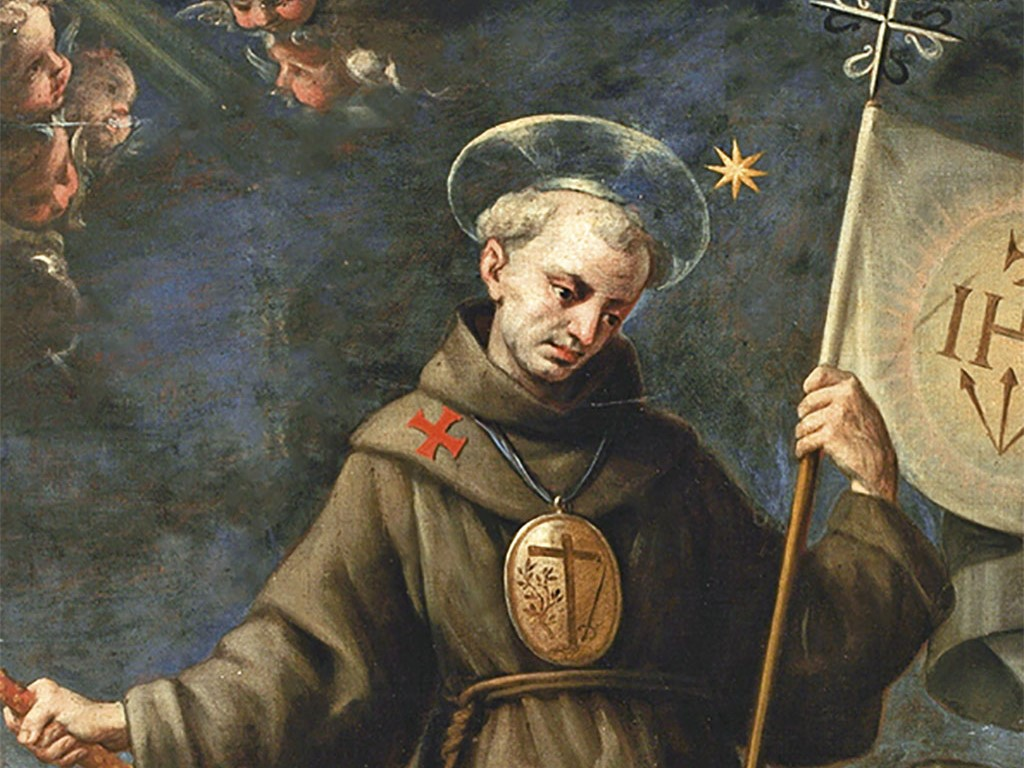
Franciscan, preacher, and warrior against the Ottomans.
He was born in 1386 in Capistrano, Italy. He studied law and worked as a judge, eventually being appointed as the king’s representative in Perugia. According to tradition, John served as a mediator in a dispute between the citizens and the king. When he failed to achieve the outcome for which the citizens had appointed him, they threw him into prison and confiscated all his property. While in confinement, he felt a calling to religious life. Upon his release from prison, John joined the Franciscans. Pope Martin V entrusted him with the mission of converting heretics as a popular preacher and establishing Franciscan friaries across Italy, Germany, Austria, the Netherlands, Poland, Hungary, and Croatia.
Capistrano is said to have been the greatest preacher of his time. Crowds flocked to hear him in such numbers that no church was large enough to contain them, so he often preached in the open air. When he was not preaching, John was writing tracts against heresy of every kind. While he was thus evangelizing, he was actively engaged in assisting Bernardine of Siena in the reform of the Franciscan Order, largely in the interest of a more rigorous discipline in the Franciscan communities. Like Bernardine, he strongly emphasized devotion to the Holy Name of Jesus.
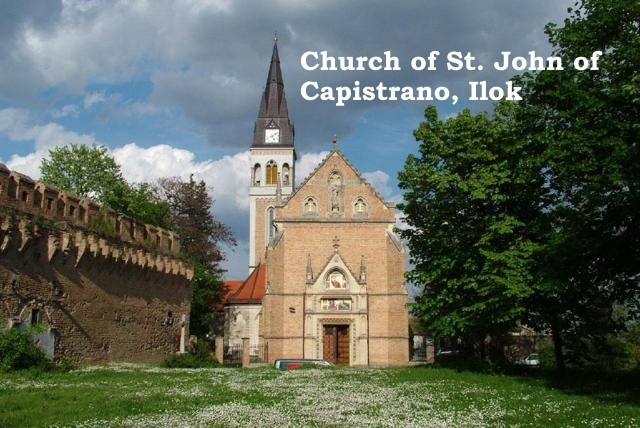
When the Turks advanced into the West, John used his oratorical skills to assemble an army for the defence of Christian Europe. On July 22, 1456, he assisted John Hunjadi in saving Belgrade from the advancing Turkish forces. Before the battle, John reportedly saw a fiery arrow descend from the sky, pointed toward the enemies of the Cross—a sign that instilled courage in both him and the Christian army. After the defence of Belgrade, John contracted the plague that was ravaging the Christian camp; he was subsequently transported by boat to the Franciscan friary in Ilok, Croatia. He died there on 23rd October 1456 and was buried in the Franciscan Church of St. Mary. Since 1700, the church was dedicated to St. John Capistrano, buried in the Franciscan church.
The year of John of Capistrano’s canonization was liturgically celebrated 16 October 1690 by Pope Alexander VIII. The Bull of Canonization, Rationis Congruit, was published on 4 June 1724 by Pope Benedict XIII.
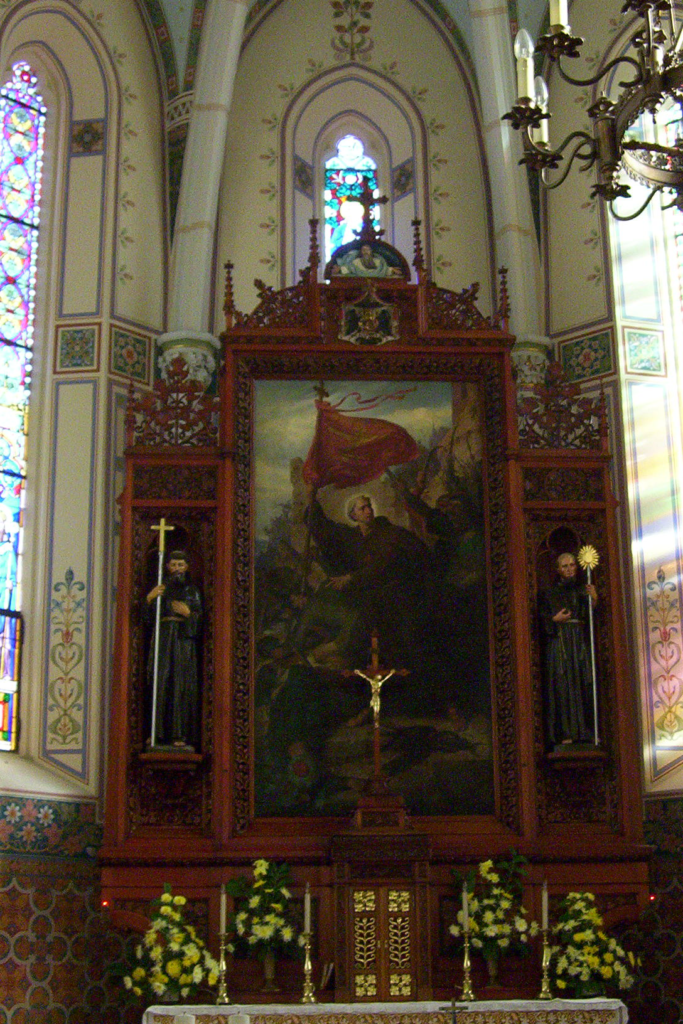
It was his wish that Franciscans should have a permanent presence in Ilok; they remained active there both during the Turkish occupation and during the Homeland War, serving as the only priests in the occupied territory. The Franciscan monastery, parish, and church in Ilok—which houses a painting of him on the main altar—are dedicated to him. The altar painting presents St. John Capistrano under the Belgrade castle, and it was painted by the Vienna painter Josip Kestler (1862). Next to the church, there is a chapel a room in which, according to the tradition, St. John Capistrano died.
In iconography, he is most often depicted wearing a Franciscan habit, holding a crusader banner and a book, or bearing a red cross on his chest. He is the patron saint of military chaplains.
For further reading – St. John of Capistrano – Combative Lion at the Service of the Church