Croatia Flag Day – June 5th

The flag of the Republic of Croatia July 25, 1990 – December 21.1990.
The current flag of the Republic of Croatia officially adopted, December 21.1990.

The Origin and History of the Croatian Tricolour

The Importance of the Flag Symbol

Flags are powerful symbols of national pride and identity, and their elements carry stories about the struggles and victories of the countries they represent. Although we usually don’t think much about the symbols that are on flags, their meaning can give us a deeper insight into the culture and values that shape a nation. The flag has existed since the very beginning of human civilisation as a systematic element of recognition. Therefore, its importance, witnessed by war and battles, became the centre of the gathering of the people. In military history, it served a special purpose, first as a symbol of armies, then military units whose tradition exists to this day.

Heraldry emerged during the age of the Crusades. From that time on, there was a clear connection of fine arts to certain laws and rules, i.e. the uniformization and codification of the way of making and presenting coats of arms and flags. It was at this time that the combination of symbols and rules that would create the basis for all today’s European and later world flags.

The Croatian flag is full of details that hide deep symbolism, reflecting the heritage and spirit of the country. The Croatian flag is one of the most important national symbols representing the identity and history of the Croatian people. Today’s flag consists of three equal horizontal stripes in the colours of red, white and blue, with the coat of arms located in the centre. The coat of arms is a shield of red and white fields, crowned by five small Croatian historical coats of arms. Understanding the origin and development of the Croatian flag and the meaning of its heraldic elements is crucial to understanding Croatia’s cultural and political heritage.

The History of the Croatian National Flag

The history of the Croatian national flag begins with the royal coronation flag, which became the flag symbol of the Croatian king and the Kingdom. One of the most important historical sources of this tradition is given to us during the coronation of King Dmitar Zvonimir. During the coronation in the basilica of St. In 1075 (or 1076), Pope Gregory VII: through the envoy (legate) Gebizon, handed over the symbols of royal honor, which include the flag:

“… I, Demetrius, who also call myself Zvonimir, by the grace of God, the prince of Croatia and Dalmatia… A king has been introduced and appointed, by you, Mr. Gebizon, an envoy of our lord Pope Gregory elected by the authority of the Apostolic See, I will rule by means of a flag, a sword, a sceptre and a crown…”

From those early days of medieval history, we can trace the flag and flag tradition of the coronations of Croatian kings. From this tradition, the first form of the state flag developed, namely the Croatian royal coronation flag. The oldest preserved depictions are coats of arms that accompany titles from the time of the Arpadović and Anjou dynasties. The earliest depiction of the Croatian flag is associated with Emperor Maximilian I  of Habsburg (1493-1519) as an illustration of the Triumphal Procession (German. “Triumphzug”). Although he was not a Hungarian-Croatian ruler, but as the successor of Emperor Frederick III (1440-1493), he aspired to the Hungarian-Croatian throne, as evidenced by his campaign against Hungary in 1490. Among the lands to which Maximilian claimed are decorative depictions of the flags of Hungary, Dalmatia, Croatia and Bosnia (“Hungarn, Dalmatien, Croatien, Bossen“). All rectangular flags feature the Queen on the throne in clothes decorated with coat of arms symbols and with a sceptre in her hand, a triangular national flag with the coat of arms and a coat of arms shield crowned with a crown. 

The oldest detailed preserved depiction of a coronation flag dates to the coronation of King Ferdinand II of Habsburg in 1618. The oldest existing Croatian state flag dates from 1647 as part of the coronation of Ferdinand IV, which is still preserved today in the Esterhazy Castle in Austria..

The Ban’s flag

In addition to the royal and coronation flags, the flags of the royal Ban also appear as symbols of the Ban’s authority. Within the Kingdom of Croatia itself, the Ban’s flag became the main state flag. From the early appearances in the late Renaissance and early Baroque periods, we begin to divide flags into two types. The first is the Ban’s standard (i.e. the flag), and the second is the crown flags for the Ban’s enthronement. As the Viceroy’s enthronement and honor was that of the viceroy  (i.e. the first representative of the king and the kingdom), his enthronement was extremely solemn. The ban carried his flag, which traditionally carried on one side the coats of arms of the Kingdom of Croatia, Slavonia and Dalmatia, and separate crown flags of these kingdoms carried by dignitaries representing the crowns at the very enthronement as a sign of authority over the lands of the Ban’s administration. The oldest depiction of the Ban’s flag is from 1620 for Ban Count Toma II (Bakač) Erdedi, while the flag of the Ban’s crowns from 1708. The oldest preserved flag is from 1670 during the enthronement of Ban Nikola III Erdedi is still kept in the possession of the Archdiocese of Zagreb. This tradition also had one interesting thing, all the Ban flags were red until Ban Josip and Count Jelačić, who in 1848 introduced the first Tricolour, which would also be worn by Ban Josip Baron Šokečević during his enthronement in 1861. Both of these flags are still preserved in the possession of the Croatian History Museum in Zagreb. The last Ban enthronement and thus the Ban Banner was introduced during the enthronement of Baron Levin Rauch in 1869, which is still preserved today and is located in the Zagreb City Museum.


History of the Croatian Tricolour

The first use of the tricolours in Croatia occurred during the reign of Queen Maria Theresa, who introduced it at the founding of the Severin County (Comitatus Szeverinensis) in 1776. The introduction of the Croatian Tricolour began in 1848 during the Croatian National Revival, as depicted on the lithograph of the May Slavic barricade in Vienna, carried by Derutin Kušlan. The tricolours became a symbol of the struggle for autonomy within the Habsburg Monarchy. The choice of these three colours would go on to become one of the most presented at the Slavic Congress in Prague in June the following year.

Ban Jelačić and the institutionalisation of the Croatian tricolour on June 5

The Croatian-Hungarian War of 1848 and the defense of the fundamental rights of the Croatian people under the leadership of the most beloved Ban Josip Jelačić imposed, among other things, the need to create a single national flag. Striving to make the Croatian national flag state-forming and acceptable to all historical provinces, the political factors of the nation gathered around Ban Jelačić decided to take the colours of the Croatian flag from the basic colours of all three coats of arms of the Croatian Kingdom.

Flag of Ban Josip Jelačić (1848)

Flag of Ban Josip Jelačić (1848)

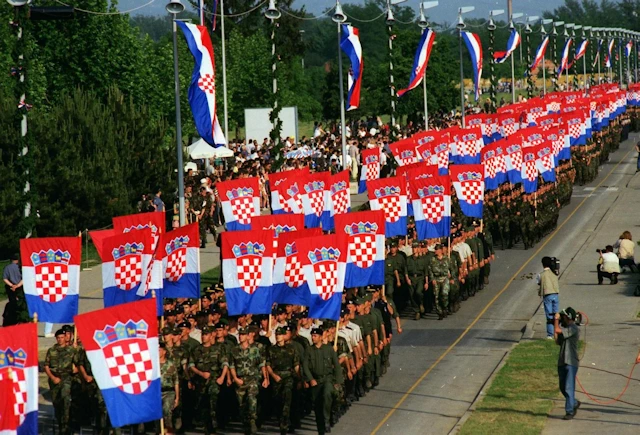
On June 4, 1848, Ban Jelačić and the National Guard in a ceremonial military procession entered Zagreb on horseback, greeted by representatives of the city and the newly appointed members of the government (Ban’s Council) that had just been formed on April 27, a week after his appointment as Ban. The procession was greeted with Croatian tricolours and showed the new direction of the then revival Croatia. The next day, June 5, on St. Catherine’s Square. In front of the church of the same name, the ancient act of enthronement began. Ban Jelačić sat on the Ban’s throne, taking over the symbols of royal – ban power, the flag and the sceptre. For the first time, the centuries-old tradition of red flags was replaced by the red-white-blue. This Croatian tricolour flag bore on one side the united coat of arms of the Triune Kingdom of Croatia, Slavonia and Dalmatia with the coat of arms of Great Illyria, while on the other the family coat of arms of the Jelačić family. Upon receiving these symbols, he took a solemn oath where he swore to defend and serve the Triune God, Our Lady and all the saints before the estates of the people and the land of Croatia, then he was raised three times by the chair in the air with shouts of glory and approval.

The memory of the second oldest use of the Croatian flag has also been preserved from 1848. We can see it proudly erected on the Slavic barricade in Vienna, where Croatian academic youth studied (above).

Flag of the Triune Kingdom of Croatia, Slavonia and Dalmatia (1848)

Legal Regulation of the flag

After the introduction of the Croatian tricolour, some time passed until the first regulations of the flag. With the collapse of the Hungarian Revolution in 1849. Franz Joseph, as the ruler of the then Habsburg Monarchy, decided to restrain national movements in the countries of the Monarchy, and ruled absolutistically. He also banned the use of national flags. Therefore, on September 10, 1852, the use of the Croatian tricolour was banned. The flags of certain countries of the Monarchy, the so-called bi-colours (landesfarben) of each country was to be used. This meant that the Croatian and Slavonian flags were allowed to continue to be used.

Croatia (1852)
Slavonia (1852)
Dalmatia (1852)

Due to the growing rebellion of the Hungarians and other peoples of the Monarchy, Franz Joseph was forced to abolish absolutism in 1860 and reintroduce certain changes. At that time, he allowed the use of the Croatian tricolour and other national flags in the countries of the Monarchy.

After the death of Ban Jelačić in 1859 and the subsequent appointment and enthronement of Baron Josip Šokčević, the Croatian flag was legally confirmed. He reintroduced it as his Ban’s flag, and for the first time the flag was clearly regulated by law. Later, his successor, Baron Levin Rauch, would reject the tricolour for the Ban’s flag, but continued to use the tricolour as the official flag,

A year after the Austro-Hungarian Compromise, the Croatian-Hungarian Compromise was concluded in 1868. According to this settlement, the kingdoms of Croatia and Slavonia preserved a certain degree of political autonomy towards the Kingdom of Hungary and the Hungarians, and these two kingdoms had the right to their own official language (Croatian) as well as the right to their flags and coats of arms, to their ban and parliament. In accordance with the Settlement, the Triune Kingdom of Croatia, Slavonia and Dalmatia received its flag and coat of arms. The red-white-blue flag had the coat of arms of the Triune Kingdom in the middle. The coat of arms consisted of three joined coats of arms (Croatian, Dalmatian and Slavonia) above which was the royal crown. Such a flag and coat of arms of the Triune Kingdom would last until the collapse of the Austro-Hungarian Empire in 1918.

The flag of Triune Kingdom of Dalmatia, Croatia and Slavonia (1868)
Flag of the Kingdom of Croatia-Slavonia with the coat of arms of the Triune Kingdom, used only in autonomous affairs. (1868–1918)
Civil Flag of the Kingdom of Croatia-Slavonia (1868–1918)

From the Croatian-Hungarian Compromise pf 1868, the Croatian tricolour flag has expressed Croatian political individuality. Together with the Croatian coat of arms, it was joined by the anthem “Our Beautiful Homeland” from 1891. Further regulations in law of the Croatian Tricolour flag were adopted in 1876, 1899 and 1914, when the descriptions of the crowned coat of arms of the Triune Kingdom of Croatia appeared in addition to the mention of red, white and blue.

During the Austro-Hungarian Monarchy from 1867 to 1918, Croatia was part of the Triune Kingdom of Croatia, Slavonia and Dalmatia. At that time, a flag with three colours was used, but without the coat of arms, because Austria limited the use of national symbols.

The Rakovica Rebellion from 8 to 11 October 1871, led by Eugen Kvaternik (1825-1871), was the first attempt to create a modern national state of Croats. Although it failed, it had a great influence on later history. Reconstruction of the flag based on modern seals and description. It is not known whether such a flag was actually made.

After the First World War , the state of Serbs, Croats and Slovenes was created from the South Slavic countries of the disintegrating Dual Monarchy – Slovenia, Croatia and Bosnia and Herzegovina. The National Assembly in Zagreb adopted the national flag, but in less than a month it was illegally integrated into the Kingdom of Serbia, which by then had already united Montenegro, creating what would later be known as Yugoslavia. This kingdom adopted as the former state’s flag, but with the reverse arrangement of colours.

The civil flag of the Banovina of Croatia (1939–1941)
The state flag of the Banovina of Croatia (1939–1941)
The flag of the Independent State of Croatia (1941–1945)

When Croatia formed the Banovina of Croatia in 1939 as part of the Kingdom of Serbs, Croats and Slovenes, it used its own flag. The civil flag of the Banovina of Croatia was the standard Croatian tricolour (red-white-blue), while the state flag of the Banovina of Croatia contained the tricolour and the Croatian ancient coat of arms. During World War II, the Independent State of Croatia retained the historic Croatian tricolour flag with the ancient coat of arms.

When the multi-party system was reintroduced in Croatia, and after the first elections, the socialist attribute was removed from the name of the Republic, and constitutional changes on June 26, 1990, removed the red five-pointed star from the flag, and in its place was placed the historical Croatian coat of arms of 25 red and white fields.

On 12 December 1990, the independent and internationally recognized Republic of Croatia determined by the Constitutional Law that its flag consists of “three colours: red, white and blue with the coat of arms of the Republic of Croatia in the centre“, in the usual horizontal order of colours.

The current Croatian tricolour flag was designed by academic painter Miroslav Šutej. The Croatian coat of arms was designed by the same author, as a shield with five smaller shields in the crown. From left to right, it contains the oldest known Croatian coat of arms, and the coat of arms of the Republic of Dubrovnik, Dalmatia, Istria and Slavonia.

The symbolism of the Red White and Blue

These three colours did not emerge as a pale copy of either Slavic ideas that were later taken over by Pan-Slavic and Russian movements, it was created as a Croatian response to our cultural revival. These three colours represent the three primary colours of our Kingdoms. At that time, three Croatian crowns under the Habsburg sceptre, which in 1848 demanded and received unity under the Croatian Ban, a wish that has been heraldically represented since the time of Ban Tomo Erdedi, and whose title dates back to the Middle Ages. In fact, these three Croatian colours are a living symbol of the meaning of the word triune, because all three colours make one body, one flag, just as the three crowns made one Croatia. This is how red describes the blood spilled for the freedom of our country and people, a reminder that Croatia is the Antemurale Christianitatis (bulwark of Christianity) that paid for its freedom with blood, which other eastern neighbouring countries do not have. White has a double symbol: the first is the peace and prosperity that our country enjoys in its freedom, and the third is geographically natural, which depicts our plains as the source of this prosperity. The third colour is blue and it is known for our Adriatic Sea, the sea that defined us as a maritime people and culture, this colour is also a sign of nobility carried by the once celebrated nation of noble Croats.

We wish all Croats a happy Croatian Flag Day!

Bog i Hrvati

PENTECOST NOVENA

“The Pentecost Novena is the first of all novenas, nine days of prayer. After Jesus’ Ascension into heaven, He commanded His disciples to come together in the upper room to devote themselves to constant prayer (Acts 1:14). They prayed for nine days before receiving the Holy Spirit on Pentecost.”

On May 9, 1897, Pope Leo XIII proclaimed: “We decree and command that throughout the whole Catholic Church, this year and in every subsequent year, a novena shall take place before Whit-Sunday (Pentecost), in all parish churches.” (Encyclical Pope Leo XIII On the Holy Spirit, DIVINUM ILLUD MUNUS )


NOVENA TO THE HOLY SPIRIT FOR THE SEVEN GIFTS


DAY ONE


DAY TWO


DAY THREE


DAY FOUR


DAY FIVE


DAY SIX


DAY SEVEN


DAY EIGHT


DAY NINE


CONSECRATION to JESUS through MARY – St. Louis-Marie de Montfort’s

The Knights of the Precious Blood are inviting you to join us in making the Consecration to Jesus through Mary according to St. Louis de Montfort. This has been an annual tradition for us since our first Croatian Men’s conference back in 2019 where a good number of the men who participated, consecrated themselves at our first Men’s Mass “Feast of Our Lady of Fatima” on the 13th of May, 2019.

Total Consecration Group – First Men’s Mass May 2019

Consecration to the Blessed Virgin Mary has been recommended by saints to all the recent Popes. From his earliest years, our late, great Holy Father – Saint John Paul II – had consecrated himself to the Blessed Virgin Mary (thus his motto, “Totus Tuus”). This consecration is extremely powerful.

You are invited in these difficult times for our families, our country, and our world to heed the requests of Our Lady at Fatima, the Saints and recent Popes, and to join the Blessed Virgin Mary’s army to help crush the head of the serpent. You are asked to make the very powerful act of Total Consecration, and to live it out in your daily life. Consecration is simply making a gift of yourself entirely to God (to Jesus through Mary) in which you surrender to Them so that They can work in and through you. They will guide you in your daily life and give you the graces to carry out what They plan for you. Those of us already living the consecration can give witness to Their wonderful Hand in our daily affairs and it is wonderful to renew your commitment to Jesus through Our Lady every year.

The St. Louis de Montfort’s form of preparation for consecration is a beautiful way to do this seriously. The preparation is a simple series of spiritual exercises that goes for 33 consecutive days, each day representing one year in the life of Jesus.

For us as is our custom we will commence on the 10th of April ending on the 12th of May. 

To access the daily readings and prayers for this powerful consecration in online digital format please use links for each day below. Also below are links to a series of talks by Fr Richard Wallace, to assist us with the consecration.


Fr. Richard Wallace Talks

Total Consecration Talk #1: Introduction     (watch before you start)

Total Consecration Talk #2: Emptying Oneself of the World  (watch day 1)

Total Consecration Talk #3: Knowledge of Self    (watch day 13)

Total Consecration Talk #4: Knowledge of Mary   (watch day 20)

Total Consecration Talk #5: Knowledge of Christ  (watch day 27)

Total Consecration Final Talk: Living Holy Slavery in Daily Life     (watch day 32)


12 Day Preparation

Day 1 – 10th April
Day 2 – 11th April
Day 3 – 12th April
Day 4 – 13th April
Day 5 – 14th April
Day 6 – 15th April
Day 7 – 16th April
Day 8 – 17th April
Day 9 – 18th April
Day 10 – 19th April
Day 11 – 20th April
Day 12 – 21st April


First week

Day 13 – 22nd April
Day 14 – 23rd April
Day 15 – 24th April
Day 16 – 25th April
Day 17 – 26th April
Day 18 – 27th April
Day 19 – 28th April


Second week

Day 20 – 29th April
Day 21 – 30th April
Day 22 – 1st May
Day 23 – 2nd May
Day 24 – 3rd May
Day 25 – 4th May
Day 26 – 5th May


Third week

Day 27 – 6th May
Day 28 – 7th May
Day 29 – 8th May
Day 30 – 9th May
Day 31 – 10th May
Day 32 – 11th May
Day 33 – 12th May


Day of Consecration
Day 34 – 13th May


To download Act of Consecration in PDF format see below.

Act of Consecration to Jesus through Mary (English)

Act of Consecration to Jesus through Mary_Cro (Croatian)

Bog i Hrvati

To Jesus through Mary

Miles Christi – AD 2026

“From Couch to Christ” – 8th National Croatian Catholic Men’s Conference

The 2026 installment of this great event in our community brought together another outstanding group of men seeking to grow a deeper relationship with the Lord, while engaging with like‑minded men to assist us on our journey.

After check‑in was completed and we settled into our rooms, the men headed to the chapel. Fr Davor once again acted as our Spiritual Director for the weekend and led us through Križni Put and Sveta Misa, ably assisted by the fine young men who served with distinction.

One of the highlights of the weekend is that everything we do is centred on Christ in the Eucharist. The days commenced with prayer and Mass, and the weekend was wrapped up with a group rosary on Sunday afternoon.

After reacquainting ourselves with the dining hall and enjoying a hearty feed, we made our way to the retreat hall for Rob’s customary icebreaker. Commemorating Fr Davor’s recent attainment of Australian citizenship, the theme for the quiz was “Australiana”. After many wooden spoons, I thought Team #3 had this one in the bag. Unfortunately, an error on a bonus question cost us dearly and left us finishing in second place, which was still much better than previous efforts.

Dr Andrew Wood was the first cab off the rank. A great friend of the Knights, Andrew spoke on the topic “Christ’s Real Presence: Why We Believe”. As always, he blew us away with his knowledge and wisdom, showing us how God reveals divine truth through Old Testament prophecy fulfilled in the person of Jesus Christ.

We kicked off Day 2 with the rosary and Mass. Following Mass was an amazing bacon and egg brekky (unfortunately, no leftovers for this one), and then it was back to the main hall for another round of talks and fraternity. On Day 2 we also had the privilege of being joined by the day‑pass holders, who all added to the fruits of the weekend through their participation.

For those of you who have not had the pleasure of meeting Fr Wallace, you missed a great opportunity! Fr Wallace is one of the most beautiful humans you could ever meet and speaks with such elegance and depth that we were all hanging on his every word. In his first talk, “The Dangers and Remedies for Sloth”, he spoke about God’s unique plan for each of us and how sloth causes us to waste our lives and miss the opportunity to implement God’s plan. This was highlighted through the Parable of the Talents and the fear that leads us to bury our gifts instead of living out God’s will. Fr Wallace gave us seven remedies to get us off the couch, including labour, prayer, fidelity to little things, a daily schedule, and learning from the lives of the saints.

Fr Wallace’s second talk was on the topic “Time: God’s Great Gift to Us”. He provided us with a beautiful Christian definition of time, one I had never heard before: “A succession of moments given to me by God as a way to love Him in this life and so attain Him in eternal life.” A striking thought followed, one we pray daily in the Hail Mary: that the two most important moments of our lives are (1) NOW, and (2) at the hour of death. Time is given to us to love God, and when you hear His voice you must say yes, as it may be your last chance at grace.

Fr Wallace left us with some practical ways to better use our time, including planning, self‑denial, patience, and ordering our relationships toward eternity.

Sandwiched between Fr Wallace’s talks was a heartwarming testimony from one of our own, Darko Topalovic. Darko’s words resonated with many of us, about his journey through an “empty” life of darkness, emotionally distant from the ones who loved him. Darko is a true example of the impact a Fraternity of Catholic Men can have on a man’s life. Darko spoke about his coming to the Lord through the sacrificial love of his beautiful wife and the deeper faith drawn through being a member of the Knights of the Precious Blood. Darko’s story is not uncommon, but Darko stands out in that he has been a great public witness to the Lord since his reversion and is a constant presence at Knights gatherings and broader Catholic men’s events. A powerful testament to what is capable when we give ourselves over to the Lord.

Following lunch, we had the afternoon free, which allowed us to relax with our brothers and purchase a bunch of books that we may never actually read. One book I would highly recommend (and one of Zoki’s recommendations to me) is Divine Intimacy—an amazing collection of spiritual reflections based on the daily Mass readings. It doesn’t need to be read cover to cover but can be slowly absorbed during daily prayer time.

The afternoon session saw Fr Rizzo unleashed upon us. He spoke on “The Mercy of God in the Sacrament of Penance” and “The Holy Eucharist: Giving Strength to Our Souls”. True to form, he delivered plenty of food for thought, not holding back in telling us where we are failing and what we need to do to love God as we were created to do. Fr Rizzo shared many personal experiences and answered the numerous questions thrown at him during the Q&A.

The highlight of the weekend is always Exposition and Benediction. Following the talks we heard during the retreat, it was beautiful to spend a couple of hours with the Lord before the Blessed Sacrament. Everyone has a different experience on the night, depending on how they have been touched over the weekend. It’s a time to take stock of where we are in our spiritual lives and to listen to what the Lord is asking us to take away and implement. Personally, it generated many emotions, and from the testimonies on Sunday morning it was clear that it had a powerful and life‑changing impact on some of the men present.

After another night battling the “snore wars” and surviving on minimal sleep, we headed to the chapel to start the day with Mass. As always, Mass was beautiful, and Fr Davor delivered another powerful homily that offered additional food for thought. While our guest speakers are rightly highlighted, it’s often overlooked that we also receive three additional talks through Fr Davor’s homilies during the weekend. They are often the whack with the sledgehammer that many of us need but don’t hear often.

The morning concluded with small‑group discussions and guidance on how we can continue to grow in our faith through Knights fraternity. There are many events throughout the year (communicated via the monthly newsletter and Signal groups), but the key events to remain connected are the parish men’s groups: Summer Hill on the first Wednesday of the month, and Blacktown on the last Sunday of the month.

The monthly Men’s Rosary Crusade is an important public witness to our faith. I encourage you to make a monthly pilgrimage to one of the many men’s rosaries held around Sydney. If all Catholic men in Sydney attended at least six per year, we would fill the St Mary’s Cathedral courtyard monthly and generate a lot more interest in the Rosary as a regular devotion.

Thank you to all the men who took time out of their lives to make the weekend a memorable experience. And for those who couldn’t attend, your prayers were gratefully received and helped make the weekend the blessing it turned out to be. I look forward to seeing you all at various events, and hopefully we can replicate what the youth are doing and fill the Benedict XVI Centre for the 2027 edition.

God bless,
Steve

Three Prophecies by Theresa Neumann to a Croatian Priest

‘Croats are the backbone of Europe’

The sermon by don Josip Mužić, a priest and writer from Split, delivered this Saturday at the shrine of Our Lady of Okita, brought a powerful message about the spiritual identity and great mission of the Croatian people.

What we are bringing should remind us of the responsibility we have as members of the Church of Croatia. don Josip Mužić’s words were summarized and published by Miljenko Jurić, coordinator of the Warriors of Mary in Croatia.

The sermon centered on a lesser-known but deeply moving historical event: the meeting of the young Croatian Jesuit Petar Perica, author of the famous Croatian song “Zdravo Djevo, Kraljice Hrvata” (Hail, Virgin, Queen of Croats), with the famous German mystic Theresa Neumann. This meeting, which took place while Perica was receiving treatment in Germany, was marked by prophetic words that, according to testimonies, strongly marked his life, but also prophesied the mission of the Croatian people.

To hear Prof. don Josip Muzic retell this story which he shared at his recent book launch “Uncompromising Catholic Politics” Non-Negotiable Principles” see => LINK

Petar Perica, a Croatian Jesuit martyred and Therese Neumann, a famous German Catholic mystic

Three prophecies

The three prophecies that, according to the tradition of his life, which is brought by Don Mužić, Therese Neumann uttered to Petar Perica are not just pious thoughts. Two have already been fulfilled in the historical circumstances of the 20th century, while the third, as Don Josip Mužić pointed out, is still being realized, the persistent loyalty of Croatian believers.

  1. Prophecy of martyrdom

Theresa Neumann announced to Petar Perica that he would die a martyr’s death. This prophecy was tragically fulfilled in 1944, when the Partisan authorities arrested Perica without trial, together with about fifty other civilians from Dubrovnik and the surrounding area. They were taken to the islet of Daksa, where they were tortured, executed and thrown into a common pit. Petar Perica thus became one of the numerous Croatian martyrs of the 20th century.

  1. Prophecy of a free and independent Croatia

The second prophecy concerned the fate of the Croatian state: that Croatia would be free and independent by the end of the century. This prophecy was fulfilled in the early 1990s, with the creation of the independent Republic of Croatia after decades of communist repression and the Homeland War.

  1. Prophecy about the spiritual mission of Croats

The third prophecy, according to Don Josip Mužić, is still ongoing. According to it, Croatia and the Croatian people are called to be the “backbone of Europe”, a people who will preserve and defend the Christian faith on a continent that is increasingly moving away from its spiritual roots.

This, as emphasized in the announcement, is now being realized through persistent witness: through dawn services, the Walk for Life, prayer in front of hospitals, public prayer in squares, through lines for confession and daily fidelity to the Gospel.

Let us recall that this last prophecy completely coincides with the prophecy received by Don Stefano Gobbi, collaborator of Our Lady and author of the Blue Book and founder of the Priestly Marian Movement.

Message 580 – “Do Not Fear, Little Flock From the blue book “Marian Movement of Priests”, Zagreb (Croatia), September 20, 1996. Italian priest, Fr. Stefano Gobbi (1930. – 2011.) To read the message see => LINK

Who was Theresa Neumann?

Theresa Neumann (1898 – 1962) was a German Catholic mystic from Konnersreuth. Known as a victim soul with stigmata on her body and for the fact that for more than three decades she lived exclusively on Holy Communion, without taking food and water. Her life was the subject of numerous ecclesiastical and medical research, and her deep piety and mystical experiences left a strong mark on the Catholic world of the 20th century.

Who was Petar Perica?

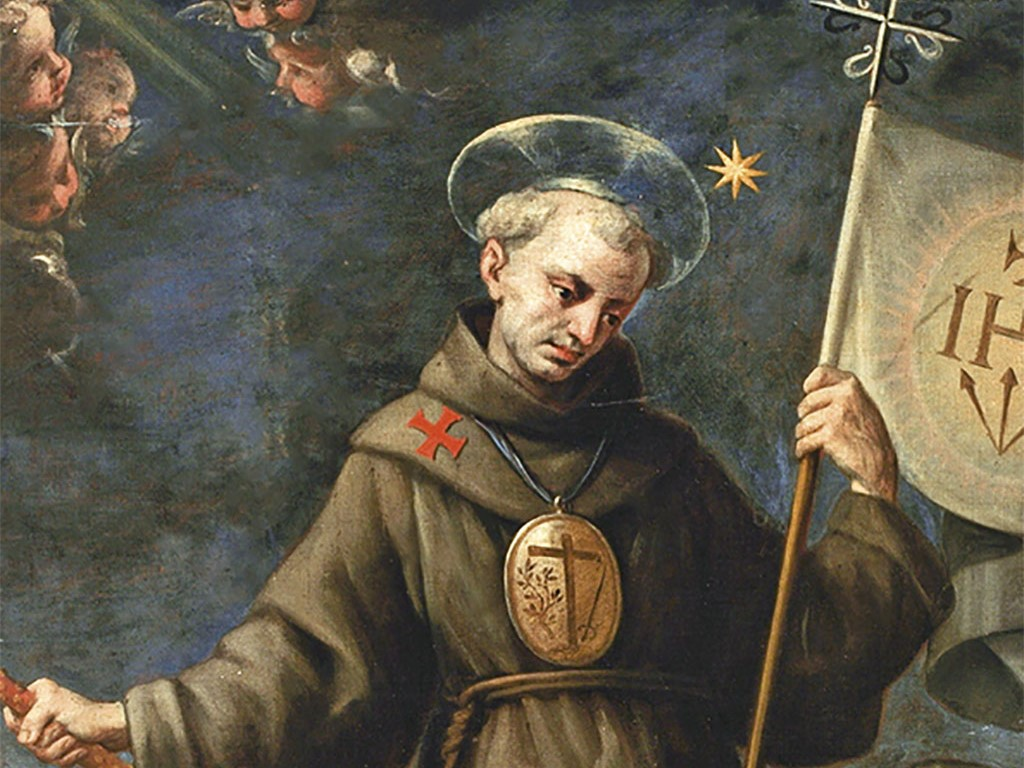
Petar Perica (1881 – 1944) was a Croatian Jesuit, poet and author of the famous Marian hymn “Zdravo Djevo, Kraljice Hrvata”, which he wrote at the age of 24. He was a youth educator and a deeply devoted priest. His martyrdom on Daxa ranks him among the prominent witnesses of faith in Croatian history.

Let us also recall the conversation with Don Josip Mužić, who also prophetically announced to us a battle greater than Lepanto if we accept the mission that heaven clearly gives us as a people in these apocalyptic times.

Source

Petar Perica – Prophesied Martyrdom

VICTIM OF COMMUNIST ATROCITIES

On October 24, 1944, the Yugoslav communists cruelly murdered Father Petar Perica, author of the hymns ‘Do nebesa’ and ‘Zdravo, Djevo’

Father Petar Perica, a Jesuit priest, was executed October 24, 1944, on Daksa, an island near Dubrovnik.

Executioners with red stars on their caps – communists, partisans, on the night of October 23-24, 1944, without cause, and without trial, killed 53 prominent Dubrovnik Croats on the island of Daksa near Dubrovnik. Among them were 7 priests, one of whom was Father Petar Perica, who wrote the famous Catholic hymns “Zdravo Djevo Kraljice Hrvata” and “Do nebesa nek se ori”.

Father Petar Perica was born in Kotišina near Makarska in 1881. He celebrated his first mass in his hometown of Kotišina on August 9, 1914, with the motto of his first mass: “Greater glory to the Divine Heart!” As a religious, he worked in Zagreb, Travnik, Split, Šibenik and Dubrovnik. From 1937, he lived in Dubrovnik. He was the superior of the Jesuit community, the administrator of the Church of St. Ignatius, a spiritual director at the Diocesan seminary, the leader of spiritual exercises and popular missions, and the spiritual leader of church societies. Because he was a Priest and raised young people in the faith, he was arrested and taken to Daksa, where he was executed as an innocent victim.

The partisans entered Dubrovnik on October 18, 1944, on Sunday, October 22, after 10 pm, arresting Fr Petar Perica. Hearing the partisans who had come to arrest him at the house of the Society of Jesus, Father Perica said briefly: “Most Sacred Heart of Jesus, have mercy on me. If it is a sacrifice, then so be it, I accept it!”

He quickly got ready, taking with him his religious cross, an image of the Hearts of Jesus and Mary, and St. Joseph. While getting ready, he constantly recommended himself with short invocations to the Hearts of Jesus and Mary, and to St. Joseph.

He repeated several times that he was willing to make the sacrifice, asked for forgiveness from the religious brothers present in the house, and said his goodbyes to them all.

Petar Perica, a Croatian Jesuit martyred and Therese Neumann, a famous German Catholic mystic

According to Don Josip Mužić, a priest and writer from Split, Petar Perica’s martyrdom was prophesied by the famous German mystic Theresa Neumann. Who announced to Petar Perica that he would die a martyr’s death, during a meeting which took place while Perica was receiving treatment in Germany.

His remains, where found and identified on Daksa, and were buried in 2010, at the Boninovo cemetery in Dubrovnik.

To date, 697 victims (369 civilians and 327 prisoners of war) from the Dubrovnik area were killed by the Yugoslav communists after the so called “liberation” in 1944 and are known by name.

The Daksa cemetery is the largest single execution site and has become a symbol of communist terror over the population of the Dubrovnik region.

This crime shows how the Partisans and Communists wanted to decapitate the Croatian people by persecuting and killing their best sons, precisely those who were the bearers of religious and social life. The countless massacres and persecutions of priests, teachers, writers, doctors and other bearers and pillars of society are a burden whose consequences are still felt by the Croatian people today. The saddest thing is that these terrible events and crimes had to be kept silent for 45 years at the cost of imprisonment and even death.

54 Day Rosary Novena

For the upcoming Men’s Conference Miles Christi 2026 which is less than two months away, as is our tradition we pray the 54 Day Rosary Novena for our Lord’s blessing upon the conference. We encourage all that can to join us, it is a great way to start praying the rosary daily, as requested by Our Lady of Fatima.

INTRODUCTION

To do the novena properly one must pray the Rosary for 54 consecutive days, without missing a day, and must pray the particular Mystery indicated for that day following the correct sequence.
That is, the first day of the novena always begins with the Joyful Mysteries (regardless of what day of the week the novena is started); the second day, the Sorrowful Mysteries are prayed; and the third day of the novena, the Glorious Mysteries are prayed.
The fourth day of the novena begins again with the Joyful Mysteries and continues on in that sequence throughout the 54 days of the novena (see Novena Charts Below).

Note: Simply click on the relevant day and it will take you to the relevant mystery and prayers for the day.

In Petition (First 27 Days)

Day No. Date Mystery
Day 1 04-01-26 Joyful
Day 2 05-01-26 Sorrowful
Day 3 06-01-26 Glorious
Day 4 07-01-26 Joyful
Day 5 08-01-26 Sorrowful
Day 6 09-01-26 Glorious
Day 7 10-01-26 Joyful
Day 8 11-01-26 Sorrowful
Day 9 12-01-26 Glorious
Day 10 13-01-26 Joyful
Day 11 14-01-26 Sorrowful
Day 12 15-01-26 Glorious
Day 13 16-01-26 Joyful
Day 14 17-01-26 Sorrowful
Day 15 18-01-26 Glorious
Day 16 19-01-26 Joyful
Day 17 20-01-26 Sorrowful
Day 18 21-01-26 Glorious
Day 19 22-01-26 Joyful
Day 20 23-01-25 Sorrowful
Day 21 24-01-26 Glorious
Day 22 25-01-26 Joyful
Day 23 26-01-26 Sorrowful
Day 24 27-01-26 Glorious
Day 25 28-01-26 Joyful
Day 26 29-01-26 Sorrowful
Day 27 30-01-26 Glorious


In Thanksgiving (Last 27 Days)

Day No. Date Mystery
Day 28 31-01-26 Joyful
Day 29 01-02-26 Sorrowful
Day 30 02-02-26 Glorious
Day 31 03-02-26 Joyful
Day 32 04-02-26 Sorrowful
Day 33 05-02-26 Glorious
Day 34 06-02-26 Joyful
Day 35 07-02-26 Sorrowful
Day 36 08-02-26 Glorious
Day 37 09-02-26 Joyful
Day 38 10-02-26 Sorrowful
Day 39 11-02-26 Glorious
Day 40 12-02-26 Joyful
Day 41 13-02-26 Sorrowful
Day 42 14-02-26 Glorious
Day 43 15-02-26 Joyful
Day 44 16-02-26 Sorrowful
Day 45 17-02-26 Glorious
Day 46 18-02-26 Joyful
Day 47 19-02-26 Sorrowful
Day 48 20-02-26 Glorious
Day 49 21-02-26 Joyful
Day 50 22-02-26 Sorrowful
Day 51 23-02-26 Glorious
Day 52 24-02-26 Joyful
Day 53 25-02-26 Sorrowful
Day 54 26-02-26 Glorious


Tomislav, the First Crowned King of the Unified Croatian Kingdom on the Adriatic – Part 3

King Tomislav – and the Roman Catholic Church

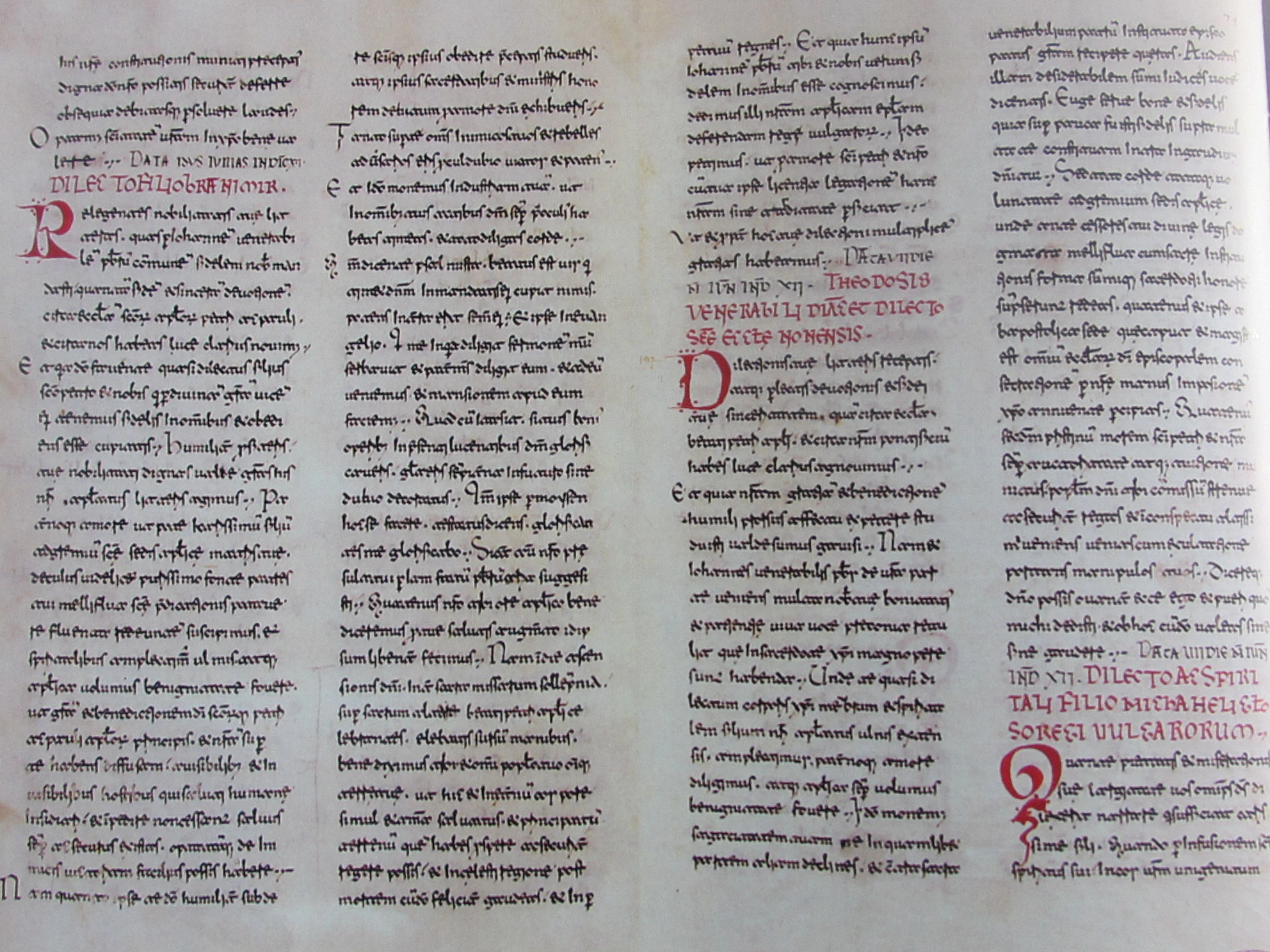
In 925, Pope John X summoned a Church Council (Synod) in Split, which was attended by King Tomislav, Knez Mihajlo Višević of Zahumlje, numerous Croatian nobles, along with Rascian nobles that previously escaped with Župan Zaharija from the Bulgarian conquest of Rascia. The Church Council confirmed Tomislav of Croatia as king (rex) of an independent and internationally recognised kingdom. Letters in which Tomislav was named as king (rex) were preserved in a version of Thomas the Archdeacon “Historia Salonitana”. In a note preceding the text of the Council conclusions in Split in 925, it is written that Tomislav is the king “in the province of the Croats and in the Dalmatian regions (…consulatu peragente in provincia Chroatorum et Dalmatiarum finibus Tamislao rege)”. In the 12th Canon of the Council conclusions in 925, the ruler of the Croats was called “King” (rex et proceres Chroatorum).

Portion of a AD925 letter from Pope John X to Tomislav in which he calls Tomislav “king”

At the request of King Tomislav, the Church Council in Split of 925 was held in order to confirm the introduction of the Latin language into all religious services among the Croats, to discuss the use of the Glagolitic script and the Croatian language and Old Church Slavonic in liturgy, and to decide which of the bishops in the Croatian territories (including the bishoprics of Dubrovnik, Ston and Kotor) and the Theme of Dalmatia would gain ecclesiastical jurisdiction. The jurisdiction was contested between Croatian Bishop Grgur of Nin (Gregory, circa 900 to 929), Archbishop John of Split, and Bishop Formin of Zadar. Up until 923, Bishop Grgur had jurisdiction over all churches on Croatian territory and was referred to as the “Croatian Bishop” (and considered the head of the Croatian National Church), but it was challenged when the bishopric of Split returned to the direct jurisdiction of Rome. At the Church Council, Pope John X was represented by Bishop John of Subiaco and Bishop Leo of Palestrina. Rome considered that only Latin symbolised and guaranteed the future of church unity. The Church Council in Split (as cited by Thomas the Archdeacon in “Historia Salonitana maior”) officially established and confirmed the recognition of Split as the archiepiscopal see of all Dalmatia (rather than just the Byzantine cities of the Theme of Dalmatia) and severe ties to the Greek Church. It also ended the autonomy of Bishopric of Nin, although Resolution XI, which was added at the request of King Tomislav and the Croatian nobility, enabled Bishop Grgur to remain in office as the head of Croatian bishops in Croatian territories. The Archdiocese of Split controlled the whole coast from Istria to Dubrovnik and Kotor. Although Pope John X sought to prohibit the Croatian liturgy and Glagolitic script, the Church Council upheld its use by local priests and monks where there was a lack of Latin priests. The Old Slavonic liturgy and Glagolitic script; along with Greek liturgy remained in official use in southern Dalmatia (including Zahumlje and Duklja), and most likely in Bosnia, as the majority of the population did not know Latin.

“Church council in Split AD925, Celestin Medović 1920

A second Church Council was held in Split in 928, with the Pope represented by his legate Madalbert who returned from Bulgaria, in order to reconsider the position of the Bishopric of Nin, but the Council upheld the supremacy of the Archbishop of Split. The Croats continued to protest against the decision and Pope John X continued to express an understanding of their wishes by not supporting and formally accepting all the decrees of the Church Council which wanted to completely abolish the Croatian Liturgy. As a result, Pope John X was forcefully removed from his position, and the Roman Catholic Church appointed Pope Leo VI (a fierce opponent of an autonomous Croatian Church with an independent hierarchy). Pope Leo VI confirmed all the resolutions from the Church Council of 928, abolished the Bishopric of Nin (which was established as the first independent Croatian Church in 879), and had Bishop Grgur transferred to Skradin.

Tomislav did not personally attend the second Church Council in Split. He may have been ill at the time, or had already died under unknown circumstances. According to the Croatian Chronicle, “…and he died.. with great glory”. According to this chronicle, Tomislav had one daughter and two sons, and ruled for seventeen years (c. 910-928). Some historians suggest that his reign may have extended until 934. He was succeeded by his younger brother, Trpimir II, who ruled as King of Croatia and Dalmatia until 935. It is possible that Trpimir II was elected King due to Tomislav potentially not having sons to succeed him, in accordance with ancient Croatian traditions and customs. Tomislav is considered as one of Croatia’s greatest kings, who liberated the Pannonian Croats from Magyar invasion, defended the Rascians from annihilation by the Bulgarians, expanded his kingdom’s borders to the Drava River, and united the Croatian people into a strong kingdom, which was respected by the Pope of Rome and the Byzantine Empire – the two greatest political powers of Europe at the time.

Source: A History of the Early Croats – Ante Mrkonjić

Bog i Hrvati

King Tomislav – years prior to and the Coronation 

King Tomislav – consolidation and expansion of the Croatian Kingdom 

The Blessing of St. Michael’s Statue in Pločice

The most important thing is to leave a legacy for our children, to know who their ancestors were.

Konavle, 18th September 2025. Parish of Our Lady of Mount Carmel, Plocice. Dubrovnik Bishop Roko Glasnovic blessed the monumental statue of St. Michael the Archangel. The statue is a gift, erected on the occasion of the 1100th anniversary of the establishment of the Croatian Kingship.

In May, the statue of Saint Michael the Archangel arrived in Pločice, major preparations began, and finally the day arrived – the day of blessing.

The monumental statue of Saint Michael the Archangel was blessed by Dubrovnik Bishop Roko Glasnović, who addressed the assembled people with selected words, including the following:

– In the Šibenik Cathedral stands a beautiful statue of Saint Michael of inestimable value, who pierced the dragon, Satan, with a spear. When they were restoring it, they said, ‘You can remove Michael from the cathedral, but you can’t remove the devil.’ He is the rock that holds, and so it is in our lives, we don’t appreciate good things, we quickly and easily remove them, and we are more preoccupied with the dark chronicle and the negative. We fall more easily under the influence of evil and wickedness than the good that someone has done for us. The same goes for words, when someone hurts you and says something unkind, it hurts us, but we forget that they said ‘I love you’ to us a hundred times. How many bad things do we remember and forget the good ones – the bishop pointed out during the blessing, adding that angels are mentioned over 400 times in the Holy Scripture.

– We read in the Book of Revelation about the heavenly war, Michael against the dragon and Michael wins. This war is not only cosmic but deeply personal. We know our battles. There are spiritual deserts, poverty, hunger, thirst, loss of love and ignorance of God. The deserts of the heart expand indefinitely, and from them the external desolations of the world sprout and then we wonder why everything happens. If we move away from God, then even man will not fare well – said Bishop Roko Glasnović.

Miljenko Jurić from the civic movement Marijini ratnici also addressed the gathered people of Konavle.

– We made an initiative for four statues, and by God’s providence, 14 such statues were created from four, some of which will also protect the people of our beautiful Bosnia and Herzegovina – said Jurić and thanked the bishop for coming and blessing.

– Why Pločice? We had the idea to place the statue on Prevlaka as the end point of Croatia, however, due to conservation rules, the decision was made to place it in Pločice. I am very happy about that because at the age of 19 I was in these fields and protected our homeland. May Saint Michael protect you and give you strength to continue, to persevere in your faith. The most important thing is that it be a legacy for our children, that they know who their ancestors were, because we did not do this for ourselves, but for our generations – added Miljenko Jurić.

– Four statues have been installed, the last dedication in Pokupskome will be on October 5th. Seven more statues will arrive on October 15th, and three are in the final stages of processing. We have financially completed the entire construction thanks to donors – he said in a statement for Dubrovački vjesnik.

The parish priest of this parish, Don Tihomir Šakota, is popular with the people, and this was best seen when we were in Pločice in May, where about 20 locals from the village and surrounding towns came to help him with the work. They then built a small square and a pedestal for the statue of St. Michael, all of them, with joint efforts, and a small children’s playground. They poured concrete, carried it, and pulled it. Tired of their jobs from which they had arrived directly in Pločice, they rolled up their sleeves and mixed the cement.

These are people who still help each other from the bottom of their hearts, where they don’t have to ask who to call to pour a concrete slab because they have been taught to be there for neighbors and friends. Proof of this is the blessed statue of Saint Michael the Archangel, which rises from today on the square near the road, right behind the sign “Pločice”.

The statue of Archangel Michael weighs 4 tons and is almost 4 meters high. It was made of marble by a Catholic Chinese stonemason, and the statue traveled all the way from China to the far south of Croatia. The Miloš, Matea and Martin family with twenty-month-old Michael were photographed next to his feet.

The original plan was to acquire four such statues and place them on the four sides of Croatia – in Pločice, Pazin, Pokupsko and Šarengrad. However, since this is the year in which the 1100th anniversary of the Croatian kingdom is celebrated, it was decided to acquire as many as 14 of them, some of which will also be placed in Bosnia and Herzegovina. Donations were collected by the Filip Neri Volunteer Association from Split, and the project was coordinated by laypeople and priests.

The parish of Our Lady of Mount Carmel in Pločice is the oldest parish in Konavle after Cavtat, and has changed borders several times throughout its history. Initially, it covered two-thirds of Konavle, the Dubrovnik Diocese reminds us on its website. The parish includes eleven villages and has eleven cemeteries. Next to the parish church in Pločice is a cemetery with 18 graves from 1892, which is no longer in use. Interestingly, the unfinished bell tower is located next to the parish house, not the church.

Source in Croatian.

Tomislav, the First Crowned King of the Unified Croatian Kingdom on the Adriatic – Part 2

King Tomislav – consolidation and expansion of the Croatian Kingdom

Although Tomislav inherited a powerful and organised state, he was immediately threatened by the Magyars from the north and by the Bulgarians from the east. The banates of the former Adriatic Red Croatia (Zahumlje, Duklja and Travunia) remained subjected to the Byzantine Empire’s political and cultural influences, whilst Pannonian Croatia was subjected to the Frankish Empire. According to Constantine VII Porphyrogenitus in his work “De administrando imperio”, Tomislav’s army consisted of 100,000 infantry and 60,000 cavalry, whilst his navy consisted of 80 large ships (Sagenas, which transported 40 mariner-warriors each) and 100 small ships (Konduras, which transported 10 to 20 mariner-warriors each, excluding rowers). The population of Croatia, based on its military strength as stated by Constantine VII Porphyrogenitus, was estimated to be approximately 2 million.

From 898, the Magyars invaded and plundered Pannonian Croatia. As a result of the Magyar raids into Pannonian Croatia, Adriatic White Croatia and Pannonian Croatia renewed the political ties and the future Bans of Pannonian Croatia were no longer subordinate to Frankish kings but to Croatian Kings. In 914, Tomislav successfully defended his Croatian lands from Magyar raids, defeating them on several occasions on the territories of Adriatic White Croatia and Pannonian Croatia. Tomislav expanded his control into Pannonian Croatia and defended the northern stronghold of Sisak. After being totally defeated by the Croatian forces, the Magyars abandoned their aspirations of invading Rome, retreated over the Drava River, and refrained from waging wars against the Croatians for nearly two centuries. By 915, Pannonian Croatia was incorporated into the state of Adriatic White Croatia by Tomislav, and was no longer subordinate to Frankish kings. It is possible that Tomislav was formally proclaimed as king of a united Croatian Kingdom by Croatian chieftains and nobles when the two states were unified in 915. During the reign of Tomislav, the Venetian navy under the command of Bragadin was defeated in a naval battle near the island of Vis in 922.

“Tomislav, the first Croatian king” by Ferdinand Quiquerez 1888. The painting depicts Župan Zaharija of Rasica seeking sanctuary and protection from King Tomislav

By 921, the Bulgarians controlled nearly all of the Byzantine territories in the southern Europe, including Rascia (a former principality of Red Croatia which was inhabited by Croats and Serbs). In 924, Tsar Symeon I sent an army to crush the revolt in Rascia under the rule of Župan Zaharija, but the Bulgarians were insufficient in number and were defeated. It is likely that Tomislav aided Rascia in its battle against the Bulgarian Empire. After the defeat, Symeon I commenced peace talks with the Byzantine Empire, but summoned a large army against Rascia with the support of Časlav Klonimirović. Upon news of the impending invasion, Župan Zaharija and some of the Rascians fled to Croatia, to the protection of Tomislav. The Bulgarian army devastated Rascia, imprisoned many of the nobles, and relocated most of the population to Bulgaria, while some escaped to the Byzantine Empire.

Under the imminent threat from the powerful Bulgarian Emperor Symeon I, in circa 923, King Tomislav, Byzantine Emperor Romanus Lecapenus, Patriarch Nicolas Mysticus of Constantinople and Pope John X were involved an agreement that formally transferred the control of Byzantine Dalmatian islands and cities of the Theme of Dalmatia to Croatia (including Krk, Cres, Rab, Zadar, Trogir, Split, Dubrovnik and Kotor). Tomislav was given the honorary title of Protector (proconsul) of the Theme of Dalmatia, and was provided with a crown sent from Byzantium. In 924, Tomislav of Croatia was formally and internationally recognised as the King of Dalmatia and Croatia by the Holy See through his acceptance of the crown from the Pope. Tomislav was formally referred to by Pope John X as “…Tomislav, King of the Croats (Tamisclao, regi Chroatorum)”.

According to the Annals of Bari, on Monday, 10 July 926, during the feast day of St. Felicitas, Croatian forces under the supreme command of King Tomislav achieved a significant military victory by conquering the southern Italian city of Siponto in Apulia. The chronicle states that Tomislav dispatched his entire army and navy, led by Ban Mihajlo Višević (referred to by the chronicler as rex Sclavorum), with the mission to expel the Saracens from southern Italy and liberate the city of Siponto. Although they did not maintain permanent control over the city, some regions of southern Italy were settled by the Croats, who were eventually assimilated into the local population by the 12th century.

In 927, Bulgarian Tsar Symeon I made preparations to conquer the newly established Kingdom of Croatia and its vassal states of Zahumlje, Duklja and Travunia (under the rule of Ban Mihajlo Višević). Although the Bulgarian Empire and the Kingdom of Croatia were at peace at the time, Symeon I wanted to conquer the Croats in order to punish them for their protection of the Rascians, and for also establishing political relations with the Byzantine Empire who the Bulgarians were at war with. Symeon I also feared that King Tomislav, as an ally of the Byzantines, would attack the Bulgarian state from the east if the Bulgarians launched another major military campaign against the Byzantine Empire. In Spring of 927, a large Bulgarian army invaded the Kingdom of Croatia from the east, but the Bulgarian advance was cut off by Tomislav’s forces in the mountain ravines. The Bulgarian army was completely decimated (cut down to a man) in the Battle of the Bosnian highlands, dated to 27 May 927. Upon hearing of the total defeat, Simeon I died of a heart attack, around 3 June 927. After the death of Symeon I “…the neighbouring peoples, Croats, Magyars, and others, decided to attack the Bulgarians.’’ Pope John X sent Bishop Madalbertus and Duke John of Cumae to Bulgaria to mediate a peace treaty between the Kingdom of Croatia and the Bulgarian Empire which was ruled by Symeon’s son Peter (927 to 969), as written in the Minutes of the Church Synod in Split in 928, and in the “Korčulan Codex”. At the time of the peace treaty, the Kingdom of Croatia was the most powerful state in south-eastern Europe.

Arabic sources also confirm the political and military power of the Croatian Kingdom under the rule of King Tomislav. During his rule, Tomislav continued with the long-lasting diplomatic relations and a military alliance with the western Arabic Saracens of the Emirate of Córdoba, which was first established in 762 between Ban Budimir Svetolik (752-780) and Abd-ar-Rahman I (756-788). The military alliance lasted until the rule of King Stjepan Držislav (969-997). Abd-ar-Rahman III, the most powerful Emir and Caliph of Córdoba (912-929) had official diplomatic deputies at the Croatian court of Tomislav, and as a sign that mutual respect and friendship, Tomislav and Abd-ar-Rahman III equally exchanged rich gold gifts and ruling insignia. Prior to the reign of Tomislav, rebel Arabic Saracen pirates frequently raided the Adriatic Coast, captured over 20,000 civilians, and sold them into slavery in the Caliph of Córdoba. During his rule, Tomislav negotiated with Abd-ar-Rahman III for the freeing of Croatian slaves who had the right to bear arms. In addition, many Croats migrated to Moorish Spain as diplomatic ties were strengthened. Through this process, the Croatians became the third most numerous ethnic groups in Moorish Spain after the Arabs and the Spaniards, and were commonly referred to as Maurohrvati (Moorish Croats). Many of the young men formed the Elite Guard of Slavic legionnaires (in excess of 6,000) and, under the command of Hadjib Badr (Badrov, an Islamised Croat originating from Korčula), became the shock troopers of the Moorish army. Abd-ar-Rahman III introduced Croatian legionnaires (referred to as saqaliba) into his court, to neutralise the endless strife between his subjects of Muslim Arab and Muslim Berber heritage. Many of the Croats rose to the ranks of generals, admirals, emirs and mayors in the Emirate of Córdoba. The Elite Guard aided Abd-ar-Rahman III in destroying the Berber rebellion, and drove out many of the rebels out of Spain and into Africa.

Source: A History of the Early Croats – Ante Mrkonjić

Bog i Hrvati

King Tomislav – years prior to and the Coronation 

King Tomislav – and the Roman Catholic Church